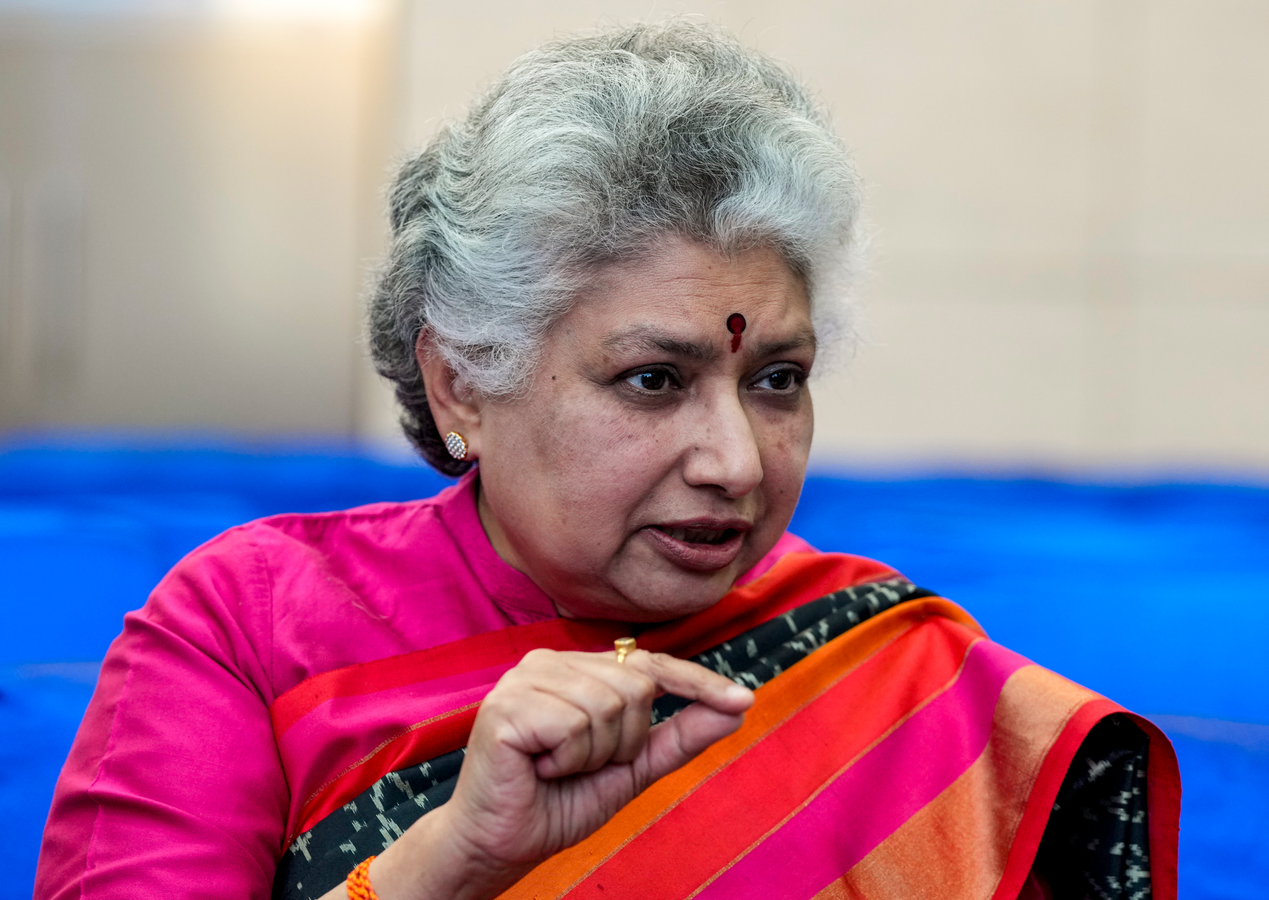
New Delhi, February 27 Supreme Court Judge Justice B.V. Nagarathna on Friday said that the media cannot perform its role under constraint, fear, or influence, and the most serious threats to press freedom arise not from direct censorship but from regulations, ownership rules, licensing laws, and economic policies.
Speaking at the presentation ceremony of the IPI India Award for Excellence in Journalism 2025, Justice Nagarathna, who is set to become the first woman Chief Justice of India in September 2027, said that the recent trend of attempts to control the press has both economic and political implications.
"A press outlet may be legally free to criticize the government, yet it may face economic constraints that make such criticism costly or unsustainable," she said.
The sole woman judge in the apex court at present said that press freedom in India occupies a unique constitutional status, and this right emerges from the interaction between Article 19(1)(a) – freedom of speech and expression – and Article 19(1)(g) – freedom to practice any profession or to carry on any occupation, trade, or business.
Justice Nagarathna, who was the chief guest, highlighted that press freedom in India is protected from two different constitutional angles. Former apex court judge M.B. Lokur and Vijay Joshi, Editor-in-Chief of Press Trust of India, also spoke at the event.
The IPI-India Award was presented to Vaishnavi Rathore of Scroll.in for her reporting on the Great Nicobar Island development project. The award comprises a cash prize of Rs 2 lakh, a trophy, and a citation.
In her speech, Justice Nagarathna said that the most serious threats to press freedom are likely to arise not from direct censorship under Article 19(2), but from regulations justified under Article 19(6).
"Ownership rules, licensing laws, advertising policies, taxation, and increasingly, antitrust laws may all be defended as economic regulations, even when they have profound effects on editorial independence. This allows the State to influence the press indirectly while maintaining formal compliance with Article 19(1)(a)," she said.
The judge further said that the constitutional challenge lies in preventing regulations from undermining Articles 19(1)(a) and 19(1)(g), and a principled approach requires recognizing that when speech and trade intersect, speech must prevail.
"A press outlet may be legally free to criticize the government, yet it may face economic constraints that make such criticism costly or unsustainable. Editors must recognize that critical coverage may lead to, for example, the withdrawal of lucrative advertising contracts, especially in the present times when governments, PSUs, and political parties are vying with each other to use the press for publicity," she emphasized.
Justice Nagarathna flagged that the law may not silence the press, but it may shape the conditions under which speech is created and certain narratives become safer, while others become riskier, long before publication decisions are consciously debated in editorial boards.
"A free press is not created by decree; it evolves through interaction between readers, writers, and editors. Attempts to control the press, whether politically or bureaucratically, undermine the very spontaneity that gives it vitality," she highlighted.
Justice Nagarathna said that media outlets may remain editorially independent on paper, yet their capacity to pursue adversarial journalism is limited by the interests of owners whose economic or political ties may be threatened by such reporting.
"This raises a normative question: if press freedom depends on economic viability within competitive markets, can it truly be free? Will there then be a free and balanced press? The press may be free from the State yet dependent on corporate power, which may in turn be dependent on State patronage," she said.
Emphasising that a challenge to free press cannot be tolerated, but must be effectively tackled at the earliest, Justice Nagarathna said, "Therefore, a restraint on free and frank reporting and an emergence of what I call 'selective journalism', for want of a better expression, must be curbed."
She highlighted that press freedom is not only a constitutional right but also an ethical practice and central to the moral authority of journalists are the twin ideals of "objectivity and impartiality".
Justice Nagarathna added that civil society must recognise that independent reporting is a public good worth paying for, and on the other hand, good journalism doesn’t run on goodwill alone.
"When someone takes a subscription, they're really saying, this kind of reporting is worth backing. A press sustained by its readers is always better placed to serve the public interest and fend off political pressures," she said.
Justice Lokur praised the role of the media in highlighting environmental related issues and said such stories generate awareness among people who can perhaps be a pressure group that may ultimately compel authorities to preserve and protect our environment.
Joshi, in his welcome speech, said there are moments when the institutions speak loudly, and there are moments when they strictly stand firm.
"Journalism at its best does both. It asks difficult questions, not to obstruct progress, but to refine it," he said.
Joshi added that in a democracy as vibrant as ours, development is often described in superlatives, the biggest, the fastest, or the largest, but journalism has a different vocabulary.
"It asks, at what cost is the development, and for whom is this development? And who decides what to give," he said.