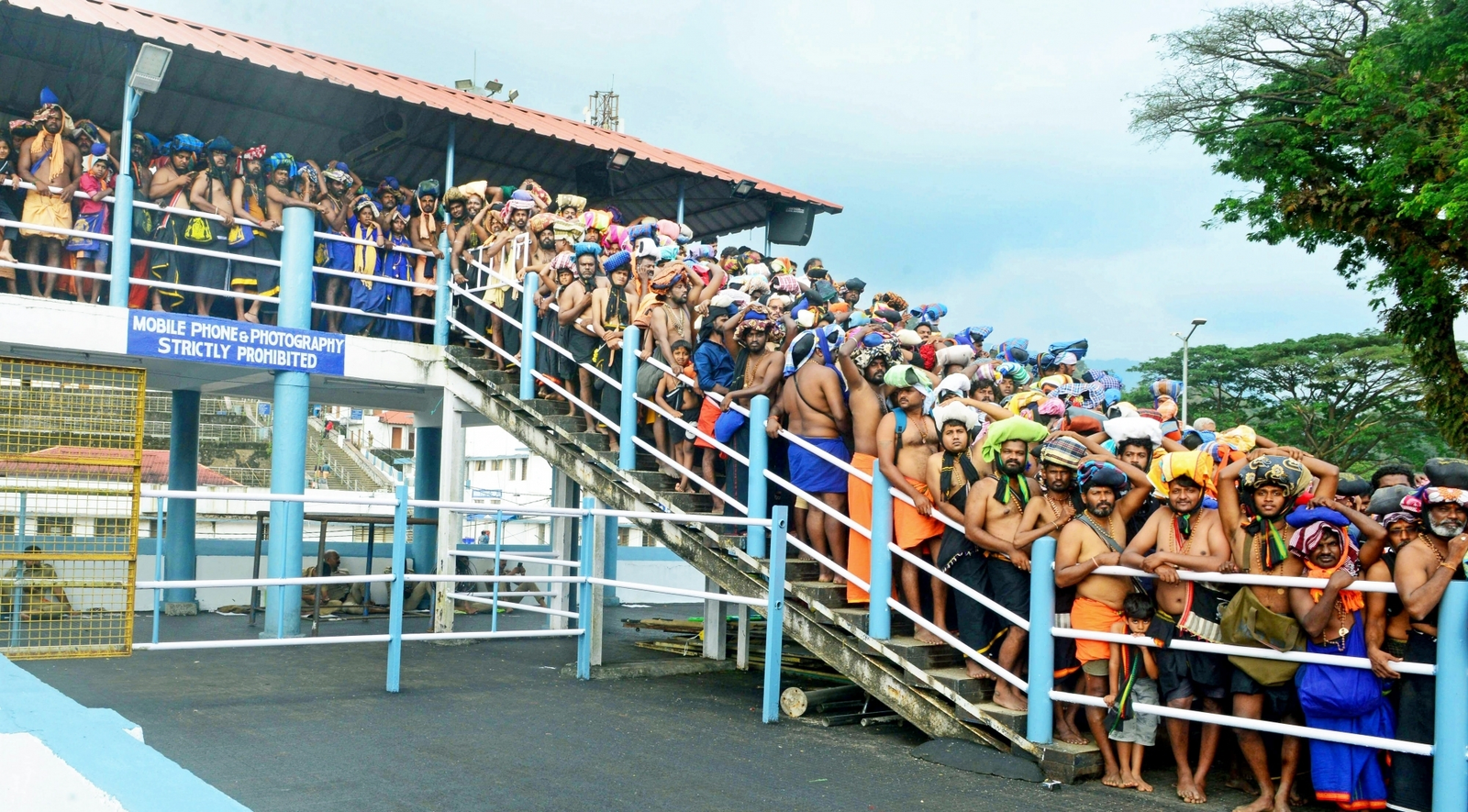
New Delhi, April 7 The Centre vehemently argued before the Supreme Court that the issue of restricting the entry of women aged between 10 and 50 years into the Sabarimala temple falls within the domain of religious faith and denominational autonomy, and is beyond the scope of judicial review.
A nine-judge Constitution bench, headed by Chief Justice Surya Kant, began hearing petitions related to discrimination against women in religious places across various religions, and the proceedings gained significance as they came ahead of crucial assembly elections in Kerala, where the Sabarimala temple is located.
Referring to the right to religious freedom under Article 25 of the Constitution, Solicitor General Tushar Mehta, representing the Centre, said that courts can intervene if religious practices violate "public order," "morality," and "health."
The top court observed that if there is a social ill branded as a religious practice, the court can examine whether it is an essential religious practice or a social evil.
The bench, also comprising Justices B.V. Nagarathna, M.M. Sundresh, Ahsanuddin Amanullah, Aravind Kumar, Augustine George Masih, Prasanna B. Varale, R. Mahadevan, and Joymalya Bagchi, was informed by Mehta that if something is unscientific, the remedy lies with the legislature.
Justice Bagchi told Mehta that courts are not experts in science, but the Evidence Act empowers the court to examine the opinions of experts and become an expert of experts.
Mehta argued that he had strong objections to an observation in the 2018 Sabarimala judgment that the exclusion of women aged 10-50 from the temple was a form of "untouchability," violating Article 17 of the Constitution.
Justice Nagarathna said that a woman cannot be treated as "untouchable" for three days in a month, and then cease to be considered untouchable on the fourth day.
"In the context of Sabarimala, I don't know how this can be argued. As a woman, it can't be that there's a three-day untouchability every month, and on the fourth day, there is no untouchability," she observed.
Mehta stated that he had no objection to the issue of menstruation.
He said that the restriction on women's entry to the Sabarimala temple was not related to menstruation, and that the restriction was only based on age group.
"Let's be clear. Sabarimala concerns only a particular age group. There should be no confusion. Lord Ayyappa temples across the country and the world are open to women of all ages. It's only one temple that has this restriction. It's a unique case," he said.
In the Sabarimala case, Justice DY Chandrachud was of the opinion that excluding women, based on age or menstrual status, from entering the temple was a form of "untouchability," placing them in a "subordinate" position, perpetuating "patriarchy," and being "detrimental to their dignity."
Initially, Mehta submitted that the "unnecessary doctrine" of essential religious practices was introduced, "but how do you decide what is essential is the question."
"It's a matter of faith. It's a matter of belief. To determine whether something is essential or not, one would first have to undertake a judicial review of religious scripture. One would have to understand the scripture in the manner in which it is meant to be understood. That, in my respectful submission, is not possible unless one attains that level of spiritual understanding," he said.
Mehta argued that India has always treated women equally, and often at a higher pedestal.
"We, arguably, are the only society that worships women. From the President of India to the Prime Minister, to judges of the Supreme Court, we bow before our female deities. Therefore, my lords, let us not import concepts of patriarchy and gender stereotypes into this discourse. These, I submit, were never inherent," Mehta told the court.
The law officer said that the Centre's submissions should not be viewed solely through the lens of the Sabarimala case, as the court is dealing with issues related to discrimination against women in religious places, which may have wider ramifications.
"I am not touching the Sabarimala part, I will deal with it in a different manner. It's a unique case. Right now, my lords are examining the legal questions and judicial policy which my lords will apply. Henceforth, it may be advisable for me not to be coloured by one particular unique case, though it is in my case that it is wrongly decided and deserves to be declared a wrong law, for more than one reason," Mehta said.
At the outset, the top court made it clear that it would not go into the merits of the Sabarimala judgment, and would confine itself to the seven questions framed in the matter.
In September 2018, a five-judge Constitution bench, by a 4:1 majority verdict, lifted the ban that prevented women aged 10-50 years from entering the Sabarimala temple, and held that the centuries-old Hindu religious practice was illegal and unconstitutional.
On November 14, 2019, another five-judge bench headed by the then CJI Ranjan Gogoi, by a majority of 3:2, referred the issue of discrimination against women at various places of worship to a larger bench.
The bench had then framed broad questions on freedom across religions, saying they could not be decided without any facts of the particular case.